What Event Planners Must Know About Live Personalisation

Updated: Jun 20
Introduction: live personalisation as part of the event experience
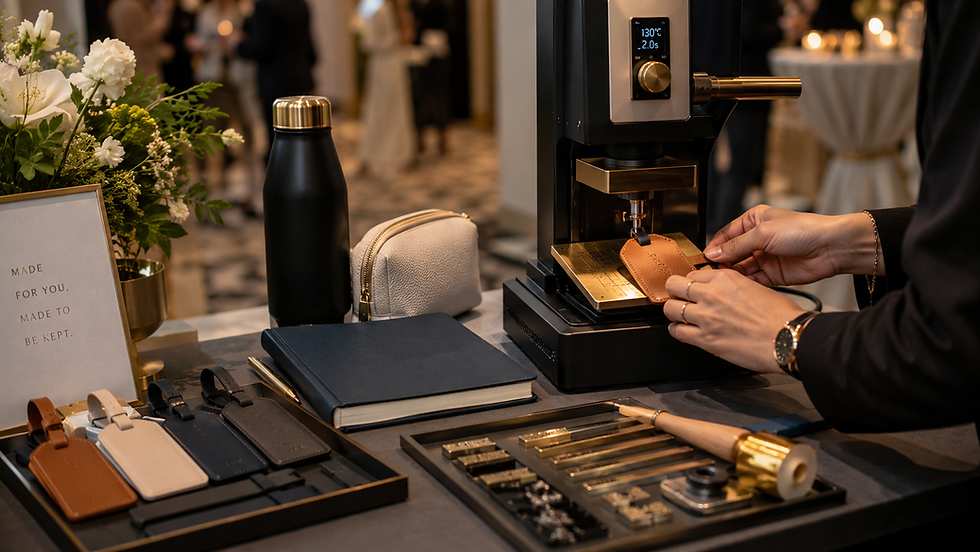
Live personalisation is often discussed as a finishing service: choose the product, add some customisation options, and place the station somewhere at the event. That can work, but it is not usually where the best results come from.
For an event team, the real question is not only whether a product can be personalised. It is whether the personalisation will work within the event itself: the guest flow, the timing, the space, the brand setting, the budget, and the kind of gift people are likely to keep afterwards.
A good live personalisation station should feel simple to the guest. They choose, watch, collect, and leave with something that feels considered. The work behind that is less simple, but it becomes much easier when the right questions are asked early.
1. Start with the guest journey, not only the product
Before choosing the technique, it helps to understand what the guest is meant to experience.
Are they choosing a gift from several options?
Are they adding initials, a name, a message or a design detail?
Will they wait while the item is made, or collect it later?
Is the personalisation station meant to create dwell time, support a product launch, encourage social sharing, or simply give people a better gift to take home?
The same product can work very differently depending on the event format. A fast-moving conference, a luxury retail activation, an internal company event and a beauty launch do not need the same level of guest choice or the same production flow.
This is why live personalisation should be planned as part of the event journey, not treated as a separate supplier detail at the end.
2. Choose the gift with the live process in mind
A product can look perfect in a deck or supplier catalogue and still be awkward for live personalisation.
The item needs to suit the brand, but it also needs to suit the setting. It should be easy enough to handle on-site, have a suitable personalisation area, work with the chosen finish, and make sense for the number of guests expected.
Some products are naturally easier to personalise live: leather tags, notebooks, pouches, compact accessories, bottles, glass markers, trays, patches, small metal items, and similar pieces with clear placement areas.
Others may need more thought. Curved surfaces, delicate coatings, very small details, unusual textures, or inconsistent materials can all affect what is possible on the day.
The point is not to avoid interesting products. Often, the most interesting work comes from figuring out how to personalise something less obvious. But the product should be chosen with enough time to test, adjust and decide whether the live version will actually feel good for guests.

3. Small design decisions can affect budget, lead time and feasibility
This is one of the easiest things for event teams to miss because the issue often starts inside the product design.
A small leather tag on a keyring is a good example. In a design presentation, the proportions can look completely reasonable: a neat name area, a refined product, a discreet place for personalisation. Once the actual size is checked, the usable space is often smaller than it first appears, because the name still needs margins, letter spacing and enough room to sit properly on the tag.
In one recent enquiry, the event team decided to allow names of up to nine characters. This would have meant using letters around 2.5 mm high. Standard brass type for hot foil stamping starts at around 5.5 mm, so our existing sets could not be used. The project needed a custom set of tiny letters, which changed both the cost and the lead time significantly.
For an event team, this affects the budget, the timeline, the guest options and whether the original idea is still practical. Issues like this are much easier to solve before the product is finalised. The tag can be made larger, the character limit can be reduced, initials can be used instead of full names, or the personalisation layout can be designed differently. Once the item has already been produced, the available solutions become narrower.
4. Guest choice should feel personal without slowing the event
Live personalisation works because the guest has some involvement in the finished item; involvement is where part of the connection happens.
But event choice needs structure. Too many options can slow the station down and make the final results inconsistent. Too few options can make the experience feel like a normal giveaway with a name added. The right balance depends on the number of guests, the event format, the time available and the level of finish expected.
For some events, initials may be better than full names. For others, a short message, symbol, colour choice or event-specific artwork may feel more relevant. A small set of well-designed options can often feel more premium than an open-ended choice that leaves guests unsure what to do.
This is especially important for brand activations and corporate events, where the gift still needs to look like it belongs to the brand. The personal detail should feel integrated, not placed awkwardly beside the logo.

5. Testing protects the event, not just the finish
Sampling is sometimes treated as a maker’s preference, but for live events it is part of risk management.
Testing helps confirm how the item will look, how long the process will take, what guests can reasonably choose, and whether the setup can work at the expected volume.
It also shows more than whether something simply works or does not work. With engraving, for example, testing can show how dark the mark becomes, whether the coating reacts cleanly, whether different tones are possible, and whether a softer setting looks more refined than a stronger one.
The same applies to foil stamping, heat transfer, patches, printing and other finishes. A product may technically take a finish, but still not give the right result for the brand or the event.
Exact samples matter because similar products can behave differently. A different coating, texture, leather finish, metal surface or production batch can change the outcome.
In the studio, there is time to adjust. Live, the point is to avoid making those adjustments in front of guests.
6. Sourcing affects what can be offered live
Sourcing is not only about finding a nice product. It affects what finishes, colours and personalisation options are realistic within the event timeline.
Some techniques depend on specific materials or coatings, and foils, vinyls, patches, blanks and effects need to be ordered in advance. Another must-know about live personalisation is that a studio cannot hold every possible colour, texture and finish for every possible request.
Heat transfer vinyl is a simple example. There are matte, gloss, metallic, flock, glitter, reflective, block, patterned and specialist options, all with different colours and supplier availability. Testing one option and then changing direction can mean another order, another delivery, another test and another delay.
The same logic applies to foils, coated blanks, metal finishes and many branded products.
This is why client-sourced items can sometimes be a practical route. If a brand already has the product or an existing supplier, the focus can move to testing that exact item and designing the personalisation around it.
When sourcing and personalisation are considered together, the event team has a better chance of avoiding late compromises.
7. Studio personalisation and live personalisation are not the same: a must-know about live personalisation
A finish that works in a studio may still need adjustment before it becomes suitable for live use. In studio production, there is more room to pause, test again, change equipment, check a file, remake it or solve an unexpected issue. At an event, the process is part of what the guest sees, which means that decisions have to be made and tested in advance.
Live personalisation does not have to be rigid - there is always some judgement involved on the day. But the main risks should already have been reduced before the station opens.
The setup needs to suit the venue.
The process needs to suit the guest numbers.
The order flow needs to be clear.
The personalisation options need to be easy to understand.
The finish needs to be reliable enough to repeat.
When those pieces are planned properly, live personalisation can feel calm and considered rather than like a production task happening in public.
8. The strongest event gifts feel designed, not simply branded
Many event gifts fail because they feel like merchandise first and a guest experience second.
A logo on a product is not enough to make something feel valuable, and a name added to a product is not always enough either. When the product, brand mark, personal detail, finish and event context feel like they belong together, the gift becomes stronger w
This does not always mean making something expensive. A simple blank product can become much more interesting through the right design decision. The same bottle, pouch, tag or notebook can feel minimal, playful, premium, corporate or editorial depending on the material, placement, colour, finish and artwork.
That is where live personalisation can add real value for event teams. It can turn a gift into a point of interaction, create a reason for guests to pause, and give the brand a physical touchpoint that feels more considered than a standard handout.

9. What Embosseur looks at before recommending a setup
Before recommending a live personalisation setup, Embosseur looks at the event as a whole.
That includes the type of event, guest numbers, timing, venue setup, product choice, brand direction, available lead time, personalisation method, artwork, material, and how guests will move through the experience.
Sometimes the right solution is fully live. Sometimes part of the work is better prepared in advance and finished on-site. Sometimes the best decision is to reduce the number of options so the finished product looks better and the event runs more smoothly.
The aim is not to make the process complicated. The aim is to make the guest experience feel simple, while the product still feels personal, well-finished and aligned with the brand.
Live personalisation works best when it is treated as part of the event planning, not as a last-minute decoration on a product that has already been chosen.
When the product, finish, guest choice and event flow are considered together, the result is usually stronger: a better gift, a calmer station, and a brand moment people remember.

Comments